Event
LA Hacks
Team
Mingxuan Gao, Shawn Wang
Social Draft is a privacy-first AI writing assistant designed to help users communicate more naturally in everyday conversations. Instead of relying on cloud-based AI services, Social Draft runs directly on-device, allowing users to generate personalized replies while keeping private conversations local. The project explores a future where AI does not replace a user’s voice, but learns from it, helping people express themselves more clearly, naturally, and authentically.
What it solves
Many AI writing tools generate replies that feel generic, overly polished, or disconnected from how real people communicate. Users often spend time rewriting suggestions to match their own tone and personality. Social Draft addresses this problem by focusing on personalization, allowing users to generate responses based on intent and communication style while maintaining complete privacy through local inference. The long-term vision is to give users ownership of an AI model that learns their preferences without sending personal conversations to the cloud.
What it does
Social Draft helps users generate natural replies from short conversation context and selected intentions such as friendly, direct, thoughtful, or casual. Rather than acting as a standalone messaging platform, it functions as a personal writing layer that can integrate with existing communication workflows. Users receive suggested responses they can edit, customize, or send, making it easier to communicate naturally while maintaining their own voice and style.
How it works
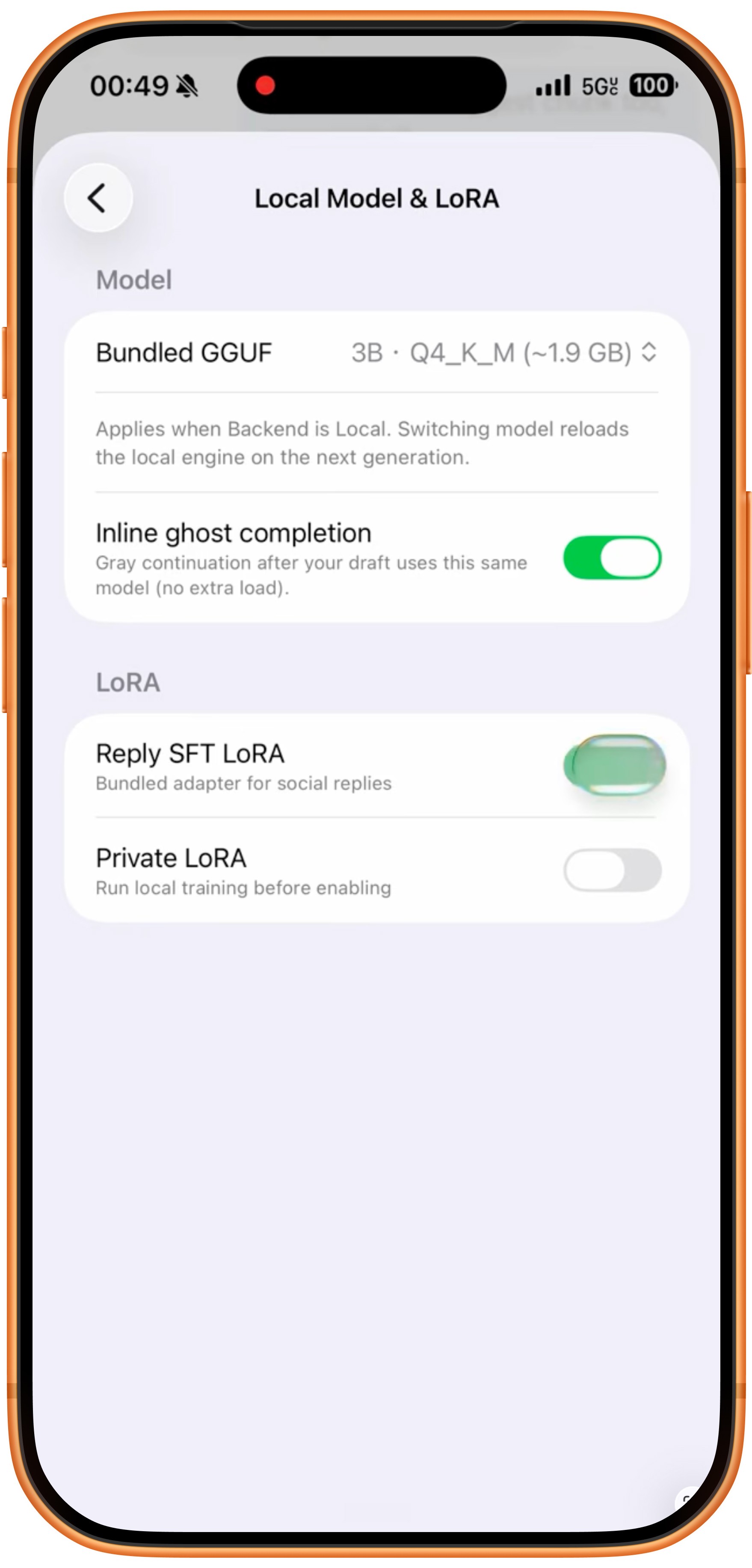
Social Draft combines on-device language models, fine-tuning experiments, and personalized adaptation techniques to create a private writing assistant. The team evaluated multiple small language models and selected Llama 3.2 3B as the foundation for local deployment due to its balance of quality and mobile performance. Running entirely on-device through quantized inference, the system generates responses without sending conversation data to external servers. The project also explores on-device LoRA fine-tuning, allowing future versions to learn from user-approved examples and create personalized adapters that improve over time. Through this approach, Social Draft demonstrates how personal AI can remain private, efficient, and fully owned by the user.