35 teams. 36 hours. One rule: the AI runs on the device.
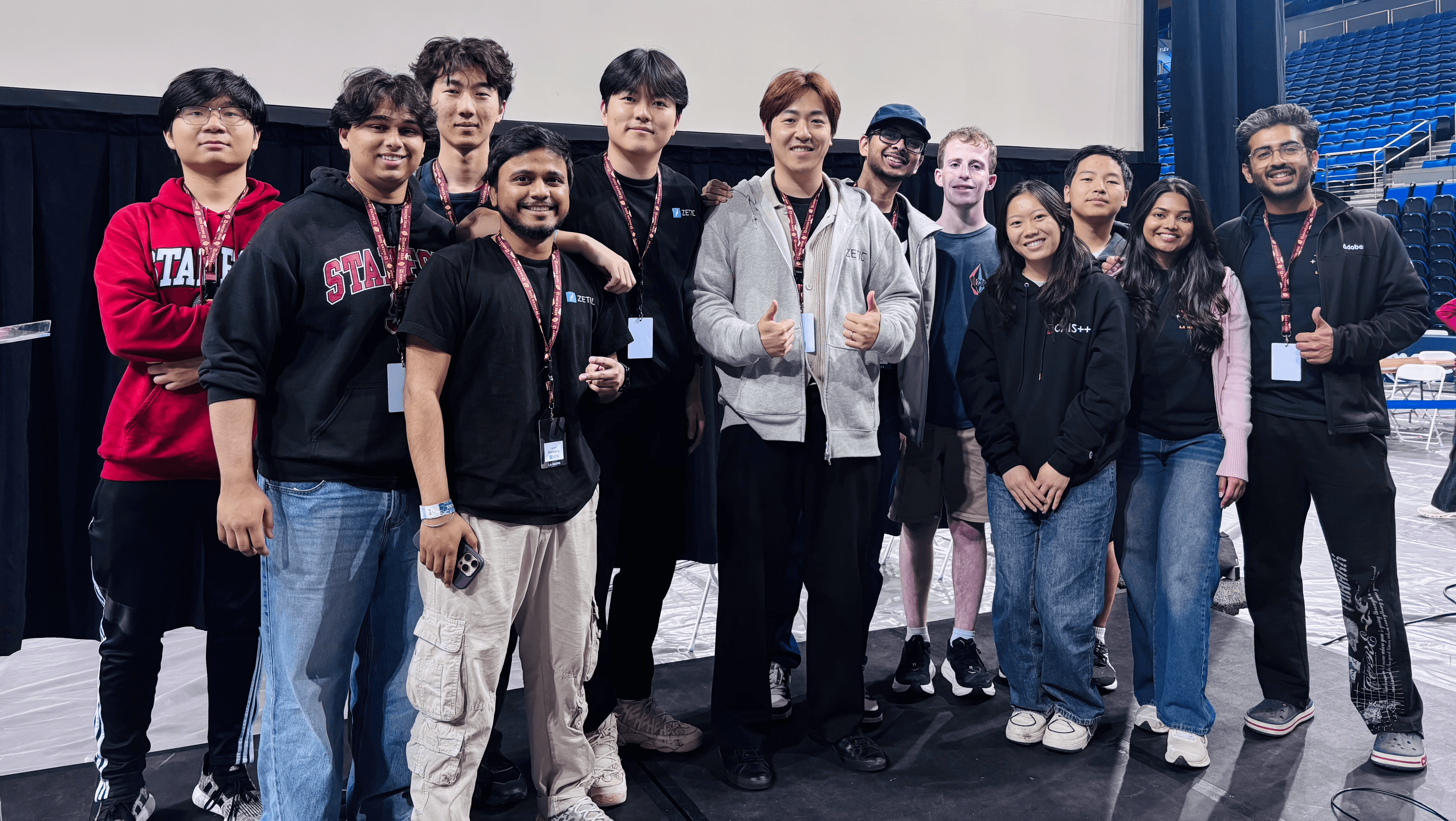
At LA Hacks 2026, held at Pauley Pavilion on the UCLA campus in Los Angeles, ZETIC ran a track challenge with a simple premise: build an AI-powered mobile app using Melange where the core functionality runs directly on the device. No cloud dependency for primary tasks. Real-time, low-latency, and private by default.
35 teams submitted projects. What they built in 36 hours changed how we think about where on-device AI is heading.
The Challenge: Building for the Edge
Most AI applications today follow the same architecture. The model lives on a remote server. The app sends a request, waits for a response, and depends entirely on a reliable connection. That model works until it does not: when a clinician is in a hospital basement with no signal, when a student cannot afford a data plan, when sensitive patient data should never leave the device.
Our challenge asked developers to flip that architecture entirely. Use Melange to select a model, benchmark it across CPU, GPU, and NPU on the actual target hardware, and deploy it locally. The four eligible domains were Healthcare, Education, Productivity, and Accessibility. Teams could interpret these broadly. Many did.
What 35 Teams Built
We expected good projects. We did not expect the range.
Teams built clinical tools that work entirely offline, AR-powered tutors that bring textbooks to life through a local voice interface, accessibility apps that convert floor plans into tactile maps, reply assistants that write in the user's own voice using a local language model, and agricultural tools for smallholder farmers in low-connectivity regions. And then there were the domains we never anticipated: wilderness safety, emergency response, stroke rehabilitation. These emerged because developers looked at the constraint of running AI locally and found problems that constraint was uniquely suited to solve.
What Melange Made Possible
Custom model benchmarked across 50+ devices in under 16 minutes
Teams were not limited to public models. Developers brought custom-trained and fine-tuned models and had them benchmarked and ready to deploy in hours, not days. SPECTRA uploaded their custom neural network and had it benchmarked across Apple, Samsung, Google, and Xiaomi devices in just 16 minutes.
26x performance improvement with zero cloud dependency
On-device deployment is not just about privacy and offline access. It is about speed. Running on the NPU via Melange, SPECTRA's model delivered a 26x performance improvement compared to a standard CPU deployment, at sub-millisecond latency with zero cloud dependency.
Scalable workflow across 35 teams
Select a model from the Melange library or upload a custom one, benchmark it across CPU, GPU, and NPU on the actual target device, deploy with a single integration. Developers who had never touched on-device AI before got a model running locally on real hardware without writing a single line of low-level hardware code.
The Winners
1st Place: SPECTRA A neural network fusing iPhone LiDAR with the RGB camera to produce industrial-grade dense depth maps entirely on-device. 99.1% pixel accuracy. Sub-millisecond inference on the iPhone NPU via Melange. Built by Ajay Shah, Benjamin Jiang, Junfeng Lin, and William Wang.
2nd Place: Knova An offline-first AI tutor built for students without reliable internet access. Adaptive, personalized, runs entirely on the device. Built by Gavin Huang, Jacob Scheff, and Yirui Song.
3rd Place: PhysioPal An AI-powered home physical therapy app with pose correction and Apple Health integration. Built by Puneet Bajaj and Rutuja Nemane.
Honorable Mentions: Northstar, Scrubs, Cropt.
What this means for On-device AI
The hardware is already there. The smartphones people carry today have dedicated Neural Processing Units sitting largely unused. The gap has never been hardware capability. It has been tooling: the infrastructure to select the right model, benchmark it on the actual target device, and deploy it without weeks of optimization work.
What surprised us most was not the winning projects. It was the breadth. Solo developers and two-person teams competed with fully staffed groups. Teams building for other tracks came to us because they needed on-device inference too. On-device AI is not a niche capability. LA Hacks 2026 gave us 35 data points that prove it.
Try Melange: melange.zetic.ai
Documentation: docs.zetic.ai
Community: discord.com/invite/gqhDWfZbgU
View all projects: Devpost