ZETIC at Computex 2026 and the Garage+ Startup Global Program

Jensen Huang from NVIDIA and Cristiano Amon from Qualcomm both keynoted at Computex 2026. They did not coordinate. But their message was identical: AI inference is moving off the cloud and onto the device.
Amon called it the "Computing Continuum." AI agents running across smartphones, wearables, vehicles, earbuds. Billions of connected devices that need on-device AI compute. Huang framed it as the age of agents, distributed, real-time, local. Two of the most influential people in hardware, standing on the same stage in Taipei, pointing in the same direction.
When that happens, it is not a trend. It is a market signal.
Why Taiwan
Taiwan owns the entire hardware stack. Chip design, chip manufacturing, OEM, ODM. Every major mobile chipmaker builds, tests, and ships out of this island. Computex is not just a trade show. It is the place where the future of compute is decided before it reaches anyone else.
That is why being here mattered.
ZETIC was selected as 1 of 17 startups from over 300 applicants for the Garage+ Startup Global Program S26 Batch. Garage+ brings promising international startups directly into Taiwan's innovation ecosystem, connecting them with C-level executives from companies like Delta Electronics, Wistron, and MediaTek. In three days, we had 15+ meetings with decision makers from some of the most important hardware companies in the world.
This is not networking. This is market development at the source.
The Question Nobody Answered on Stage
Both Jensen Huang and Cristiano Amon made the case for on-device AI. Compellingly. What neither answered was the question every developer in the audience was already thinking:
How do you actually deploy models across NPU, GPU, and CPU without months of engineering work?
Snapdragon has its stack. Apple Silicon has its stack. MediaTek has its stack. Exynos has its stack. They are all different.
The models are ready. The hardware is ready. The deployment layer is not.
That is the gap ZETIC is building for.
What We Demoed at the Booth
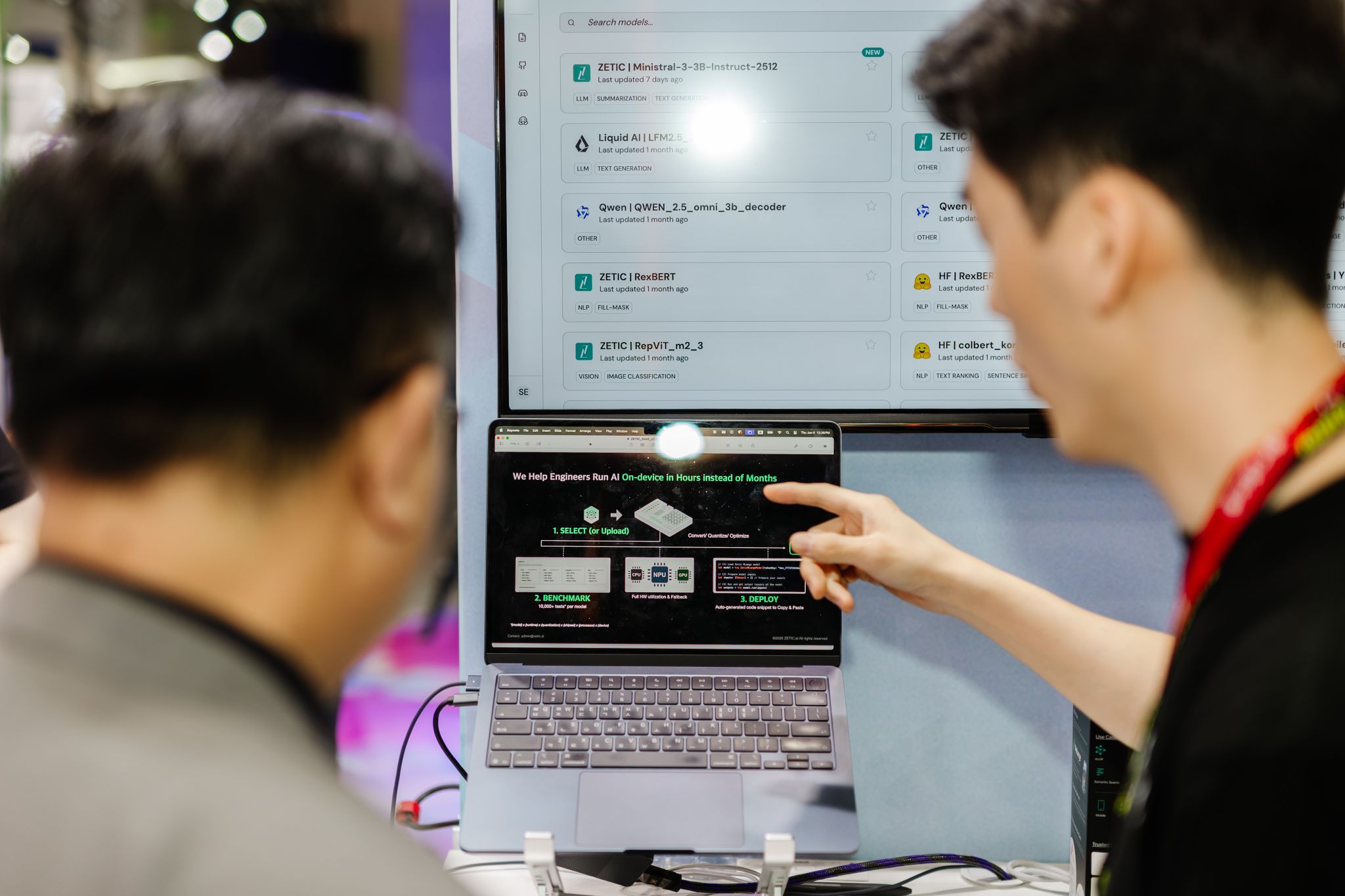
At theGarage+ Pavilion, we demoed Melange.
Three steps: Select, Benchmark, Deploy.
Pick any model from the library or upload your own.
Benchmark it across NPUs, GPUs, and CPUs on real devices.
Get production-ready SDK code in Java, Kotlin, or Python. Copy it, paste it into your app, and ship.
The conversations at the booth confirmed what we already believed. Engineers understand the problem immediately. The question is never "why does this exist." It is always "how do I get access."
On-Device AI Needs a Bridge
Taiwan has the chips and the devices. The model ecosystem is exploding. Apple, Google, Qualcomm, and NVIDIA are all validating the on-device thesis at the highest level. But between a model and a device, there is still a gap that nobody has cleanly solved.
ZETIC is building that bridge. Any model. Any device. In hours.
Computex 2026 made it clear that the shift is not coming. It is already here.
The teams who will win are the ones who solve deployment, not just inference.
We are grateful to Garage+ for their support throughout the program. The access, the meetings, and the time in Taiwan were invaluable.
The hardware is ready. We are building what comes next.
Learn more about Melange at melange.zetic.ai