Turn off your Wi-Fi. Does your AI app still work?
For most, no. Something in there is quietly calling a server.
So we set the hardest version of that problem. Build for the Moon, where there is no cloud at all.
They Could Have Been Anywhere
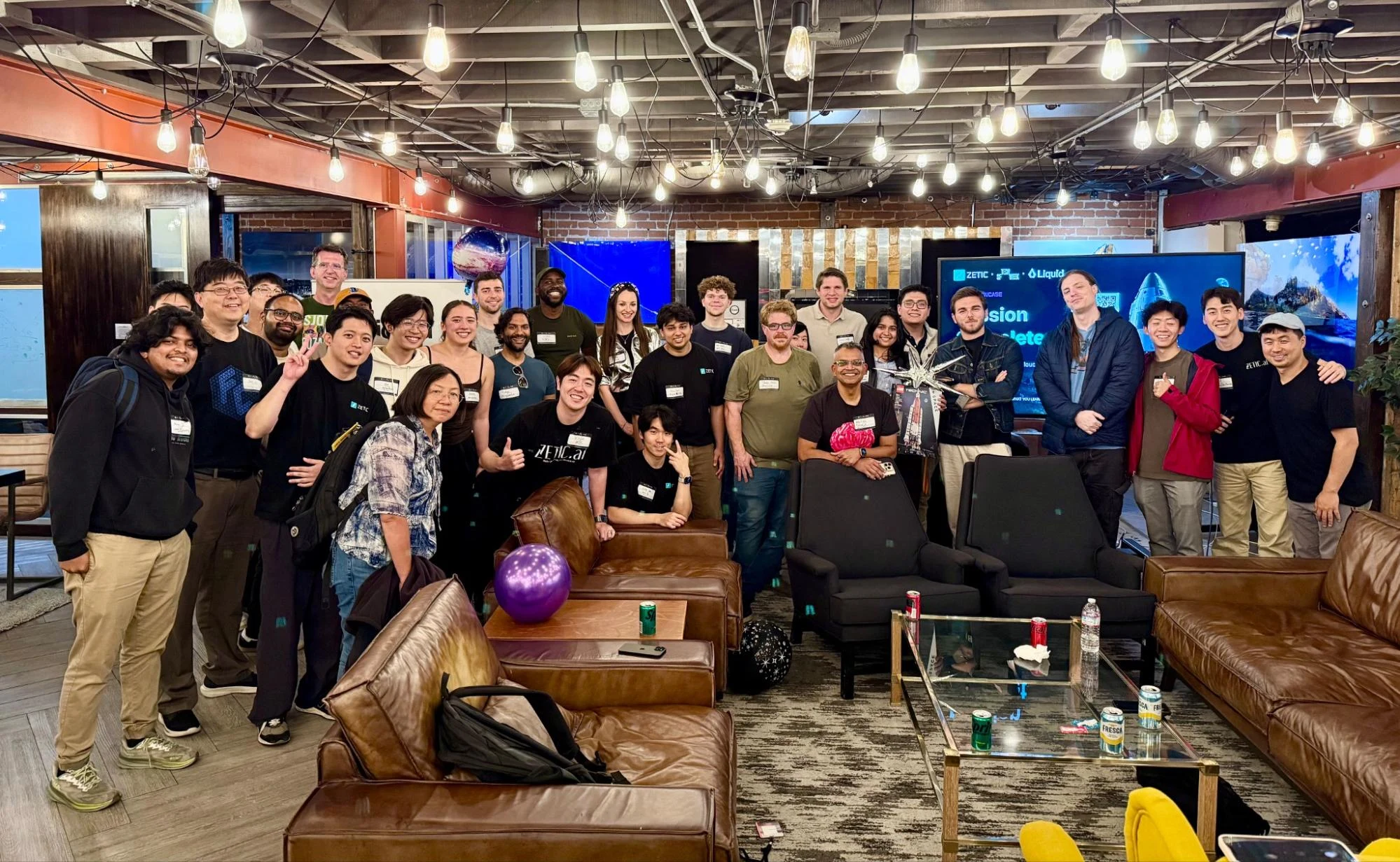
It was a Tuesday night during SF Tech Week. Within a few blocks of 181 2nd Street there were open bars, rooftops, panels, and every other reason not to spend an evening hunched over a laptop. 369 people put their name on the list anyway.
The ones who showed up brought laptops, phones, and data cables.
The assignment was easy to state and harder to do. Pick a lunar scenario. Configure a Liquid model. Connect it to local tools. Deploy it on the device in your pocket. One hour.
Then, at 7:30 p.m., the network goes off, and we find out whose assistant survives.
Why That Is Harder Than It Sounds
A model that runs on a phone has to meet two constraints at once, and they pull against each other. It has to fit in the memory the device will actually give you, after the operating system and the camera stack and every other app have taken their share. It also has to be good enough that someone wants to use it.
Most model evaluation ignores the first constraint completely. Benchmarks run on hardware with no memory ceiling worth worrying about. Then the model meets a phone and the numbers stop meaning anything.
Liquid AI builds for the other side of that line. Liquid Foundation Models (LFMs) span 230M to 24B+ across text, vision, and audio, and the small ones are not shrunken large ones. They are designed down.
LFM2.5-350M has sixteen layers with a 3:1 ratio of short convolution to grouped-query attention, an architectural choice made because of where the model has to run rather than in spite of it.
Then comes the part that catches people out.
The speed of a model on a device is not a property of the model. It is the product of six things:
model × runtime × precision × processor × chip × device
Change any one and the answer changes. The same model at the same quantization can be fast on one phone and unusable on another, because one has a neural processing unit (NPU) the runtime knows how to target and the other does not.
A precision setting that wins on one chip costs you on the next. There is no mental model that gets you to the right combination, and no spec sheet that tells you either, because silicon rarely behaves the way its documentation suggests.
So you stop reasoning about it and start measuring it.
What Melange Made Possible
Melange builds every quantization and processor path it can for a given model and device, benchmarks them on physical hardware, and routes to the one that actually wins. Not a simulator. A real phone on a rack, running the thing.
Melange today
100+ real devices. 100+ models. 180,000+ benchmark runs. Every number measured on physical hardware, across generations of iOS, iPadOS, and Android devices.
For the LFM family
345 tokens per second. The fastest output speed measured.
91 milliseconds. The fastest measured time to first token (TTFT).
Every device in the set. On every Apple, Samsung, and Xiaomi device benchmarked, at least one LFM ran at a speed you would ship.
That last line is the one that matters. It is not that a model runs well somewhere. It is that whatever phone you have in your pocket, Melange has a model and a configuration that runs well on it.
Crews took one of two routes to get there. The dashboard for the visual path: browse the library, pick an LFM, benchmark it against your target device, deploy. Or the command-line interface, the same pipeline from a terminal, development environment, or coding agent.
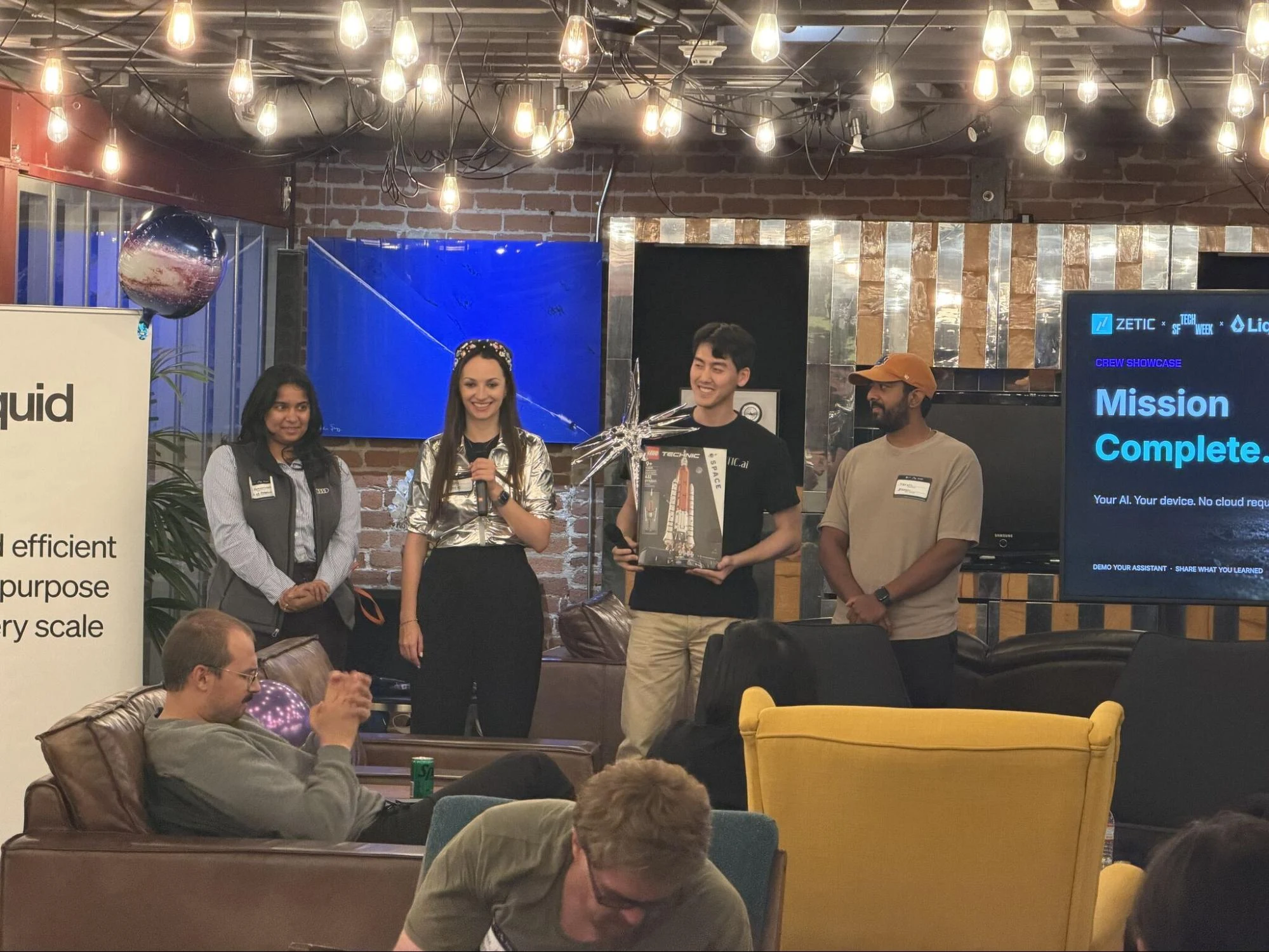
Viviana Márquez, Developer Relations at Liquid AI, and ZETIC’s co-founder and CBO Seongjun Kim ran the room as mission guides, with ZETIC engineers on hand for anyone who hit something strange.
Then the network went off.
It is a cheap trick and it works every time, because it proves something slides cannot.
The inference is not somewhere else. There is no fallback. The tokens are free, the latency is whatever your silicon can do, and the data never leaves the device because there is nowhere for it to go.
The Crews Delivered
We expected working demos. In one hour, we did not expect the range.
Hail Mary won the room with one app built for a bad day in space: an alien language translator, for the obvious contingency, and an emergency spacecraft control guide agent, for the moment something fails and the manual is not going to load.
Another crew built an on-device vision-language model (VLM) black box for a spacecraft. A flight recorder that can actually see.
Others built voice-guided space explorers, assistants you talk to when your hands are busy and there is nobody within range to ask.
As Viviana put it afterwards, it was a glimpse of what is possible when AI runs directly on your device: useful, creative tools that keep working even when the signal does not.
The premise was a joke. What people reached for was not. Every one of those is a tool whose entire value is that it works in the exact conditions where a network does not exist. Give developers that constraint for an hour and they go straight to the problems that genuinely belong to it.
That is the part worth keeping. On-device is usually argued as a cost line or a privacy checkbox. Put a room of developers inside the constraint and they build things that could not exist any other way.
Even the Sky Got the Memo
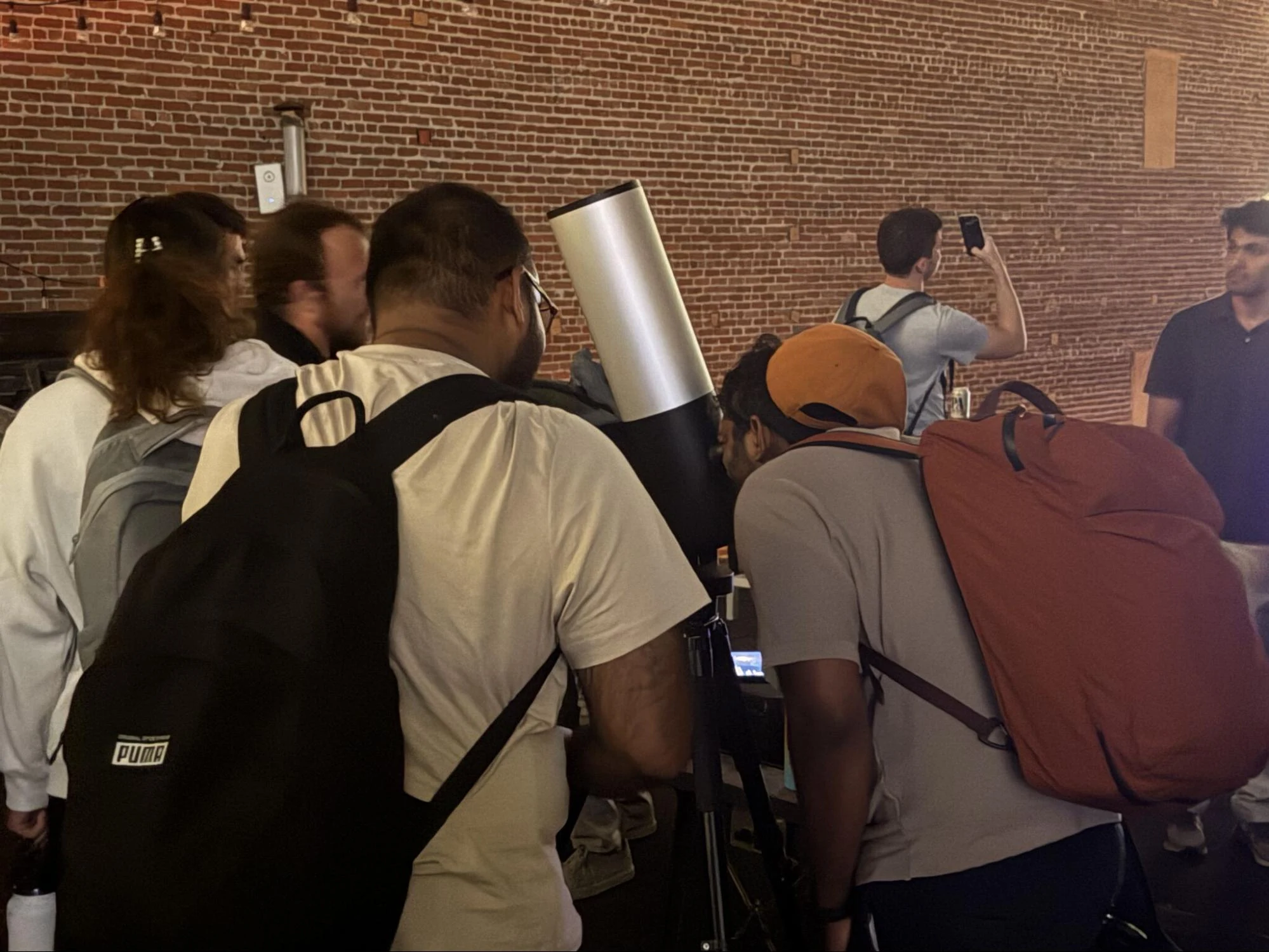
We ended the night outside with telescopes and astronomer Brian “Astro” Castro, looking at Saturn and a nebula.
Houston, we had no cloud. Not in the apps, and not overhead.
Build One Yourself
Everything from the night is available now.
The LFM family is live in the Melange model library: LFM2.5-230M, 350M, 1.2B, and 2.6B, plus the LFM2.5-VL-450M vision model.
Browse the models: melange.zetic.ai/model-library
ZETIC docs: docs.zetic.ai
Liquid AI: liquid.ai · LFM models · docs.liquid.ai · Hugging Face
Pick a model, benchmark it against the device you actually care about, deploy it, then turn your Wi-Fi off and see what you have.
Thanks to Viviana and the Liquid AI team, to Brian Castro for the telescopes, to everyone who came and built something, and to TECH WEEK by a16z for having us.
Follow along: ZETIC on LinkedIn and X. Liquid AI on X and LinkedIn.
No cloud required.