ZETIC at VivaTech 2026 and the Tech For Change recognition

The day before VivaTech opened, French Prime Minister Sébastien Lecornu did not wait for the conference to start.
On June 16, he announced that France's domestic intelligence agency, the DGSI, would end its contract with Palantir and move to ChapsVision, a French-built alternative. The same week, he announced €655 million in government spending on sovereign AI, including a single conversational assistant for approximately one million French civil servants.
His position was direct: France cannot rely on tools developed by foreign powers. France must have its own tools.
That announcement set the tone for everything that followed at VivaTech 2026.
What VivaTech 2026 Was Actually About
The official theme was "Artificial Intelligence, Impact Not Illusion." The unofficial theme, present in almost every conversation on the floor, was sovereignty.
France and Germany issued a joint declaration on digital sovereignty at the event. The European Commission's Vice President for Tech Sovereignty attended and spoke. Jensen Huang delivered the GTC Paris keynote on AI factories and sovereign compute. The question being asked everywhere was the same: who controls the infrastructure that AI runs on?
ZETIC was there, as part of the SBA Seoul Business Agency Pavilion. We were there because that question is the one Melange was built to answer.
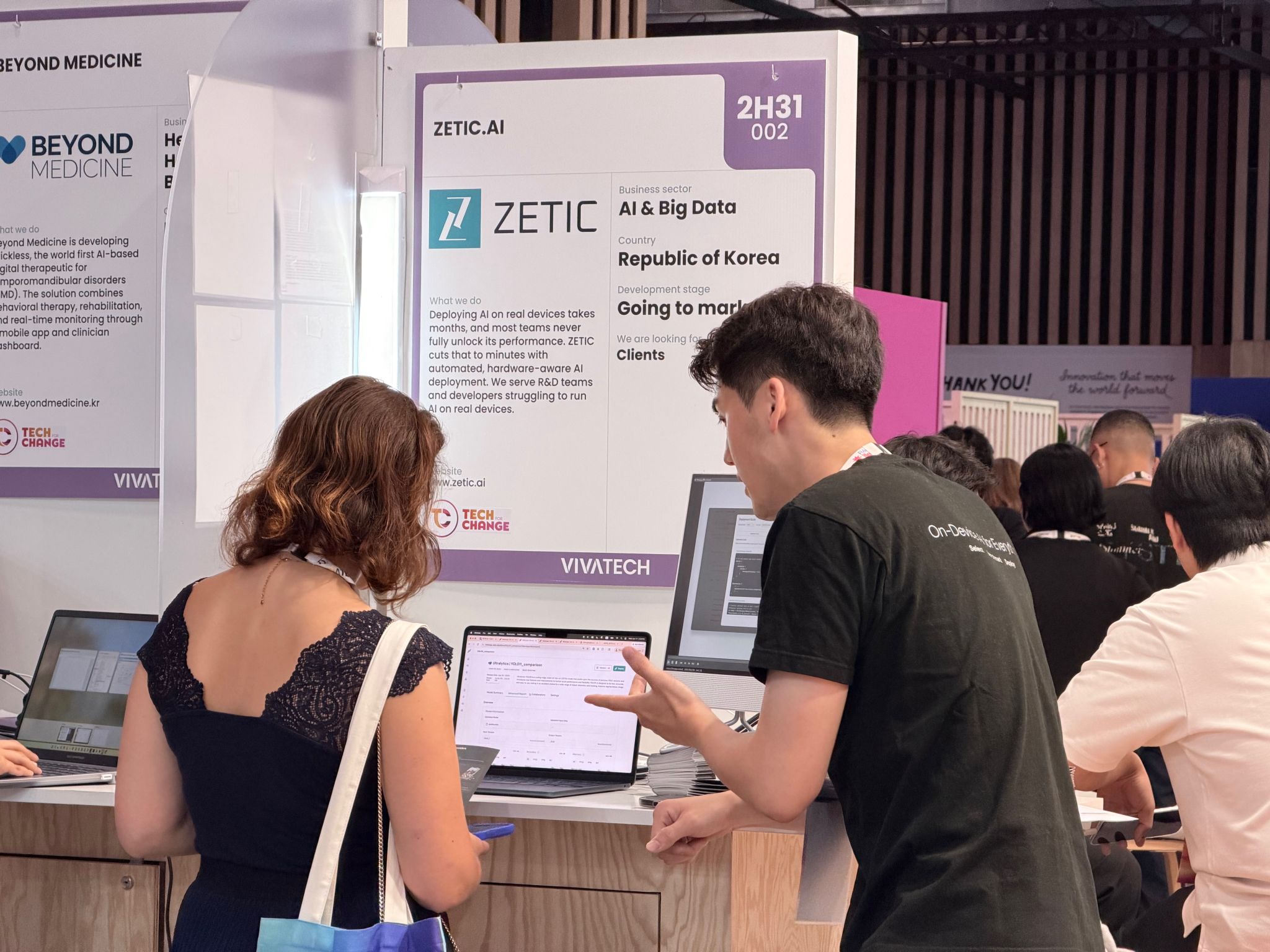
Tech For Change 2026
VivaTech officially recognized ZETIC as Tech For Change 2026, in partnership with UNESCO, WWF, and Les Echos. The criteria: measurable positive impact, strong technology, and business viability.
The environmental case for on-device AI is not abstract.
Microsoft's energy usage is up 168% since 2020, according to the company's own 2025 sustainability report. Google's greenhouse gas emissions have grown 51% between 2019 and 2024, according to its own environmental reporting.
By 2030, data centers are projected to consume 945 terawatt-hours of electricity globally, up from 448 terawatt-hours in 2025, according to a June 2026 UN University (UNU-INWEH) report. That comes with a projected water footprint of 9.3 trillion liters per year. Meanwhile, billions of edge devices are already sitting in pockets, factories, cars, and homes. Many already have a chip powerful enough to run AI locally.
The recognition from VivaTech confirmed what we have believed from the beginning. Moving AI off the cloud is not just a sovereignty decision. It is an environmental one. And it is already possible today.
What We Heard on the Floor
The conversations at the booth made something clear.
European enterprises are not just curious about on-device AI. They are building procurement requirements around it.
Engineers from energy companies came with a concrete problem: vision inspection systems that need to run directly on hardware in the field, without any network connection. Factory operators needed malfunction detection running on the machine itself, not routed through a remote endpoint. In every case the reason was the same. Network dependency is a liability. Data leaving the device is a risk. Latency is a constraint they cannot engineer around.
These are not edge cases. These are the conditions that define industrial AI deployment in the real world. And they are exactly the conditions ZETIC was built for.
The question at the booth was never why on-device AI matters. It was always how to get it running on specific hardware, without months of engineering work.
That is the question ZETIC answers.
Select a model. Benchmark it across NPU, GPU, and CPU on real devices. Deploy with production-ready SDK code. Any model. Any device. In hours.

The Answer Is Not Another Cloud
ChapsVision replacing Palantir solves part of the problem. Scaleway replacing Azure for French medical data solves another part. But both are still cloud infrastructure. The data still travels. The inference still routes through a server. The dependency still exists, just under different ownership.
The deepest form of sovereignty is when the AI runs on your own hardware, with no call to any external system, no data leaving the device, no dependency on any network. That is what ZETIC enables.
The Signal Is Clear
At Computex 2026, Jensen Huang and Cristiano Amon both stood on stage and pointed in the same direction. AI inference is moving off the cloud and onto the device.
At VivaTech 2026, a prime minister moved first. A government agency canceled a contract. A joint Franco-German declaration defined sovereignty as controlling your own hardware stack.
The policy environment is catching up to what the technology already makes possible. The enterprise demand is already here.
We are grateful to VivaTech, UNESCO, WWF, and Les Echos for the Tech For Change 2026 recognition. And we are grateful to everyone who came to Hall 7 and told us exactly what they are building.
Sovereignty starts at the device. We are building the infrastructure to get there.
Learn more about Melange at https://melange.zetic.ai/