OASIS:Offline AI Emergency Response Companion for Critical Situations
#HealthcareAI
#EmergencyResponse
Event
LA Hacks
Team
Aaron ShinGyu, Jin Lee
OASIS is an offline-first emergency response companion built at LA Hacks 2026. Designed for situations where connectivity is unavailable or unreliable, OASIS provides structured emergency guidance directly on a user’s phone. Whether responding to a hiking injury, natural disaster, or medical emergency in a remote area, OASIS delivers reliable, protocol-based assistance without requiring internet access. The project was inspired by a simple question: why does the device we always carry become least useful when help is hardest to reach?
What it solves
Many emergency assistance tools assume internet connectivity, but emergencies often occur in environments where networks are unavailable. During disasters, infrastructure failures can disable cellular service, and remote outdoor environments frequently lack coverage altogether.
Traditional AI assistants introduce another problem: hallucinations. In high-stakes medical situations, incorrect instructions can have serious consequences.
OASIS addresses both challenges by combining deterministic emergency protocols with on-device AI. Critical decisions never depend on model-generated responses, ensuring users receive reliable, evidence-based guidance even when completely offline.
What it does
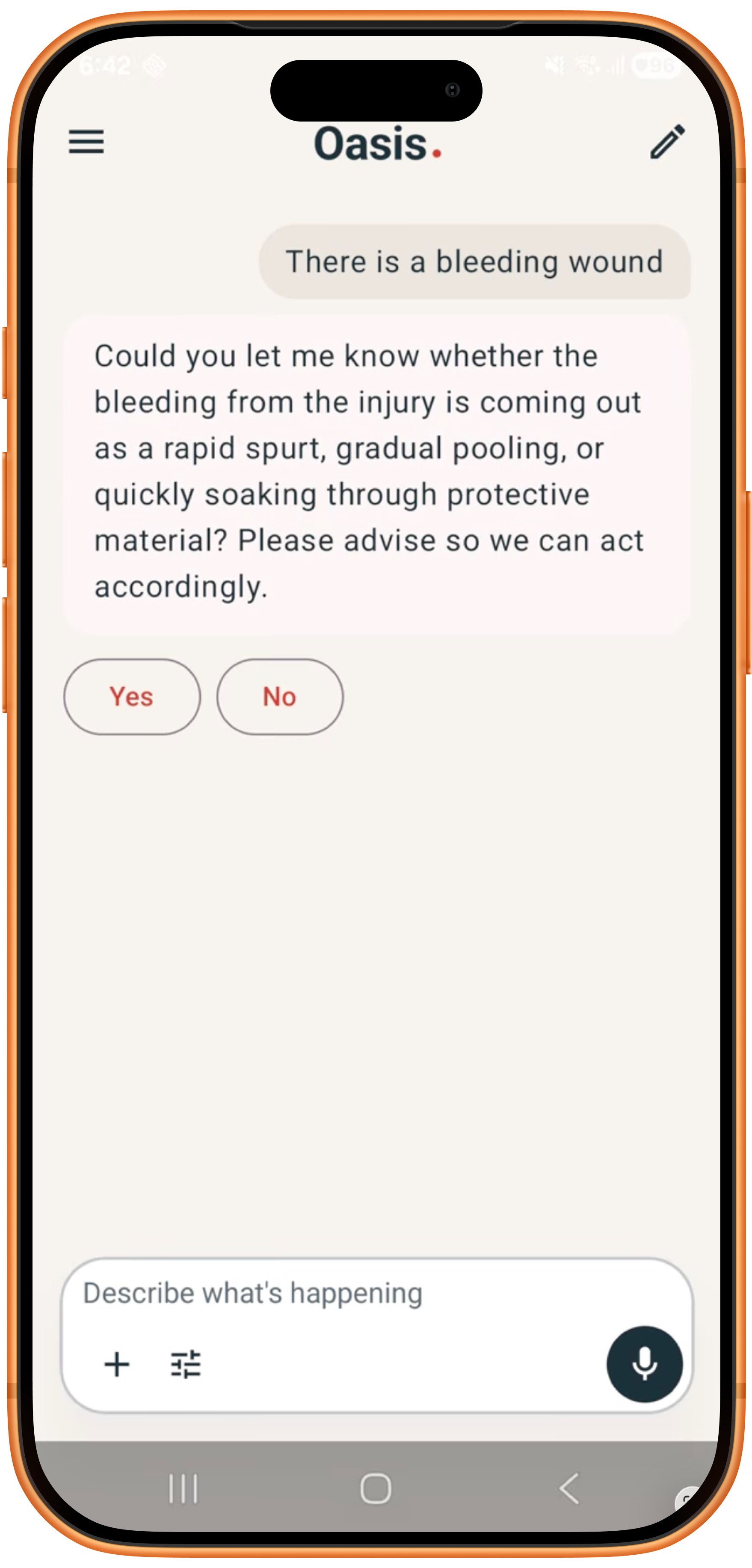
OASIS guides users through emergency situations using structured triage and response workflows.
Users can describe a situation or follow guided emergency protocols covering scenarios such as:
CPR and unresponsive patients
Choking incidents
Severe bleeding
Stroke and cardiac emergencies
Seizures and head injuries
Burns and fractures
Hypothermia and heat illness
Poisoning and allergic reactions
How it works
OASIS uses a hybrid architecture that combines deterministic emergency protocols with on-device AI running through ZETIC Melange. Emergency workflows and canonical first-aid procedures are stored locally and managed through a structured decision tree system, ensuring critical decisions never depend on AI-generated outputs. An on-device LFM2.5-1.2B language model provides personalized explanations and guidance, while a validation layer ensures responses remain faithful to the original protocol. By running the entire inference pipeline locally, OASIS delivers reliable emergency assistance even when users are completely offline.
App UI




Models used
These are the models used:
LFM2.5 (on-device LLM for personalized emergency guidance) via ZETIC Melange
Try Melange: https://melange.zetic.ai